This site uses HUGO which is a simple website builder that creates static pages. Pages that are created on the server, the computer, and are displayed as-is. They are not built on-deman, on-the-fly. They just exist.
It’s a simple concept, light weight and easy to manage from my end. Creating this page in HUGO means I enter the text and format it in the most basic way possible. I do it on one of my computers, then push (send it to the server) it, and it appears when you you or I click on the link. Simple.
Too simple - what I wanted was just a little more sophistication - create, edit and manage new articles on the server (the cloud computer where they reside), not my home computers. Create an article like you create a note or document on your computer.
Enter AI.
I have no idea if anyone has created a layer of software I can add to HUGO, simple and quick, that does what I want. I don’t have a lot of requirements:
- Simple layer - hopefully open source and free.
- Just plugs-in (I’ll explain shortly)
- Let’s me create, edit and delete articles.
Go to ChatGPT (or Claude or Gemini, or
Prompt :I want to have a website with articles and maybe other media in the future. as Lightweight as I can - Hugo is a product I use now for some sites. very light weight. too light sometimes. i’d like hugo better if I couold edit in place, wysiwyg style.
Notice the typo!
It gave me back a list, with thumbnails, and links to 5 products I could add on. Then:
One additional candidate is Sveltia CMS, a modern alternative to Decap. It’s worth including in your Hugo experiments.
Followed by
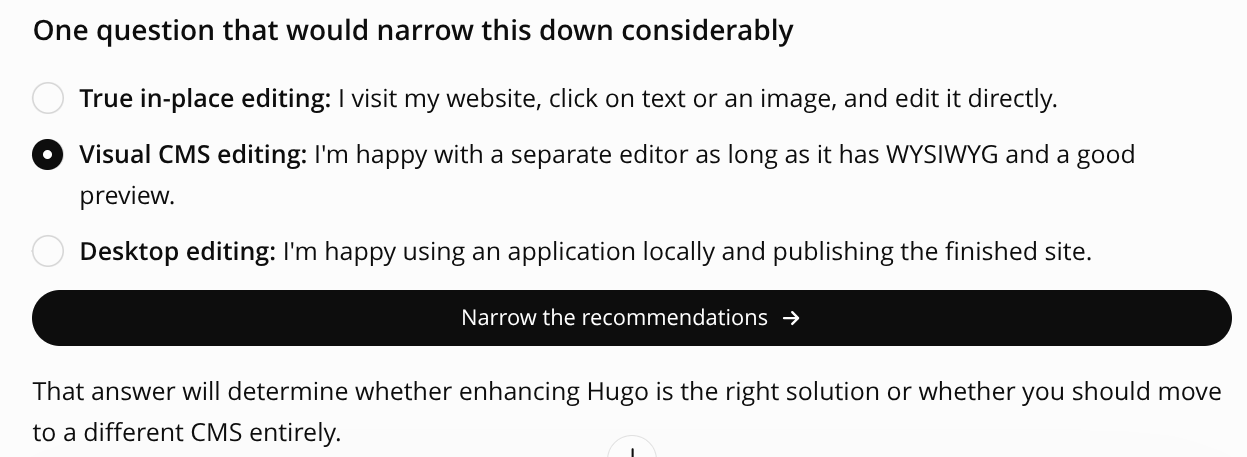
I hit “Narrow the recommendations” and it delved into Sveltia CMS. I won’t dive into the use and configuration here. It’s not the point of this article. This is what plug-in I referred to early means.
If you click on Sveltia CMS link, you’ll be taken to Github which is where the project and it’s code lives. Not sure what this means - research yourself. I’ll cover this in future articles too - but don’t wait - research.
The point is this is one of the way you use LLM’s. You know what you want, you think as clearly as you can, and prompt it. Then continue your conversation to drive to what you want.